Architecture
This page explains how Agent Kourier is put together: what it owns, what the agent runtime owns, and the path one conversation takes through the broker.
Agent Kourier connects declarative messaging bindings to agents deployed with a chosen runtime. The runtime hosts and executes the agents. Agent Kourier owns the messaging connection, conversation lifecycle, and delivery state.
flowchart LR
    Slack["Slack channel<br/>People and alert messages"]
    AgentKourier["agent-kourier<br/>Bindings, sessions, delivery"]
    Agents["A2A agents<br/>kagent, Google AX, any streaming A2A agent"]

    Slack <-->|Messages, answers| AgentKourier
    AgentKourier <-->|A2A| Agents
The kagent path
A message from Slack becomes a turn in the session manager, which sends it to the agent through the kagent-v1
dialect. Every call goes through a front door that verifies the Binding's token; the controller port is never reached
directly. The answer streams back and is rendered into the thread, and durable posts go through the outbox.
flowchart TB
    Slack["Slack channel"]
    subgraph AK["Agent Kourier"]
        Intake["Slack adapter and chat intake"]
        Session["Session manager<br/>reply queue, turns, recovery"]
        Client["A2A client<br/>kagent-v1 dialect"]
        Render["Renderer and outbox"]
        Store[("SQLite or Postgres")]
    end
    Door["Front door<br/>verifies the Binding's token"]
    Ctrl["kagent controller"]
    Agent["kagent agent<br/>on Agent Substrate"]

    Slack -->|message| Intake
    Intake -->|queue a turn| Session
    Session <-->|task| Client
    Client <-->|A2A 1.0 and HITL extension| Door
    Door <--> Ctrl
    Ctrl <--> Agent
    Session -->|output, questions| Render
    Render -->|post, stream, edit| Slack
    Session <--> Store
    Render <--> Store

    classDef core stroke:#326CE5,stroke-width:3px
    class Session core
The Google AX path
The broker is the same; only the dialect and what sits in front of the agent differ. AX has no message model of its own, so the agent is an A2A server you build and run as an AX Task, and it verifies the Binding's token itself.
flowchart TB
    Slack["Slack channel"]
    subgraph AK["Agent Kourier"]
        Intake["Slack adapter and chat intake"]
        Session["Session manager<br/>reply queue, turns, recovery"]
        Client["A2A client<br/>a2a dialect"]
        Render["Renderer and outbox"]
    end
    Gateway["TLS gateway<br/>A2A endpoint and card only"]
    Router["atenet-router<br/>ate-target-actor header"]
    Agent["A2A agent in an AX Task<br/>verifies the Binding's token"]

    Slack -->|message| Intake
    Intake -->|queue a turn| Session
    Session <-->|task| Client
    Client <-->|A2A, questions as text| Gateway
    Gateway <--> Router
    Router <--> Agent
    Session -->|output, questions| Render
    Render -->|post, stream, edit| Slack

    classDef core stroke:#326CE5,stroke-width:3px
    class Session core
The whole map
The full map adds configuration, Secrets, interaction handling, telemetry and both runtimes in one picture. It is too large to read at page width: open it full size.
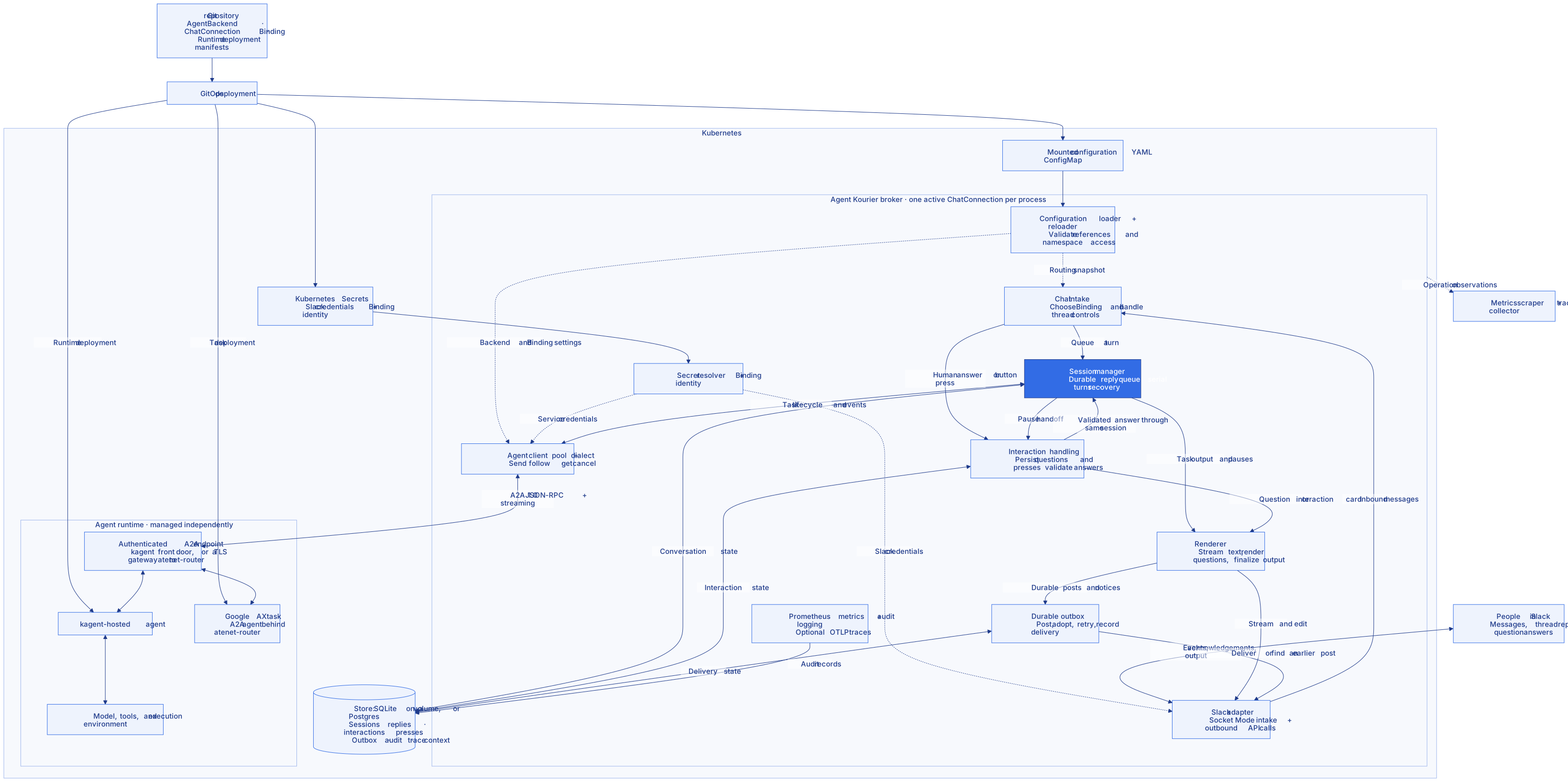
The full map. Select it to open it, and select it again to see it at full size and drag it; or open the SVG in a tab of its own.
In the full map, solid arrows show the configuration and conversation paths, and dotted arrows show configuration or credential inputs. The kagent and AX runtimes sit behind the same A2A client; they differ only in dialect and in what the backend exposes. Telemetry is shared across broker operations rather than a step in delivery. Audit records are durable in the store; traces are exported only when configured.
Configuration and deployment
The current pilot reads resource-shaped YAML files from AGENTKOURIER_CONFIG_DIR.
GitOps deploys those files as a ConfigMap alongside Secrets, the Agent Kourier
Deployment, and persistent storage. The reloader validates changes and keeps the
last accepted configuration if a reload fails. Secret access uses Kubernetes
RBAC; cross-namespace resource references use configured namespace allowlists.
The broker selects one active ChatConnection per process. Multiple bindings
can route its channels to different agents and backends. The current deployment
uses SQLite; this diagram does not imply an active-active, shared-database broker.
Live Agent Kourier CRDs and a reconciliation controller are planned. Agent Kourier does not
deploy an agent when it loads an AgentBackend or Binding: the runtime's own
manifests, operator, or deployment tooling handle that lifecycle.
One conversation
- The messaging adapter feeds an inbound message to chat intake, which selects the binding and applies the channel and thread rules.
- The session manager persists the reply and runs turns in order. The agent client uses the binding's service identity and backend dialect to call A2A.
- Task output feeds the renderer. Live streams and edits go through the chat adapter; durable posts and notices go through the outbox.
- When the agent needs a human answer, interaction handling persists the pause and renders its question. An accepted answer resumes the same agent task.
- On restart, persisted sessions, pending interactions, and outbound rows allow recovery and reconciliation. Saved trace context connects asynchronous work.
Structured questions and approvals depend on the backend's interaction contract.
The generic A2A dialect supports text continuation: a plain-text input-required
question is persisted and posted, and a thread reply is accepted under the same
membership, audit and deadline checks as a button press before it is sent to the
paused task. The kagent dialect additionally understands its structured HITL
extension (tool approvals, tool step cards).
Google AX is a supported backend. AX speaks A2A, so it uses the a2a dialect with
no ax-specific code. The AgentBackend points at ax's atenet-router and selects
the actor with a static ate-target-actor header from spec.headers; the agent is
an A2A server running as an ax task, which you build and run (ax ships none). No
front door sits in this path, so the agent must verify the Binding's bearer ID token
itself, as the reference agent does (issuer, audience and subject), or an
OIDC-verifying proxy must sit in front of a TLS gateway to the router. Chat, queued replies, restart recovery, actor suspend and resume, and
in-thread text answers are tested in the AX kind tier. Structured tool approvals and
tool step cards are kagent-only; the generic dialect leaves them opaque. ax's own
lifecycle (task, template, egress policy) stays with the operator. See the
AX reference agent and the
AX kind tier.
Source map
| Responsibility | Source |
|---|---|
| Resource types | api/v1alpha1 |
| Composition and shutdown | internal/broker |
| Configuration and Secret resolution | internal/config |
| Messaging contracts and Slack adapter | internal/chat |
| Conversation execution and recovery | internal/session |
| A2A clients and backend behavior | internal/agent, internal/dialect |
| Human interactions | internal/interact |
| Output and durable delivery | internal/render/live, internal/outbox |
| Persistence and observations | internal/store/sqlite, internal/telemetry, internal/audit |
See the specification for the detailed contracts, and Logs and traces for the trace boundaries.